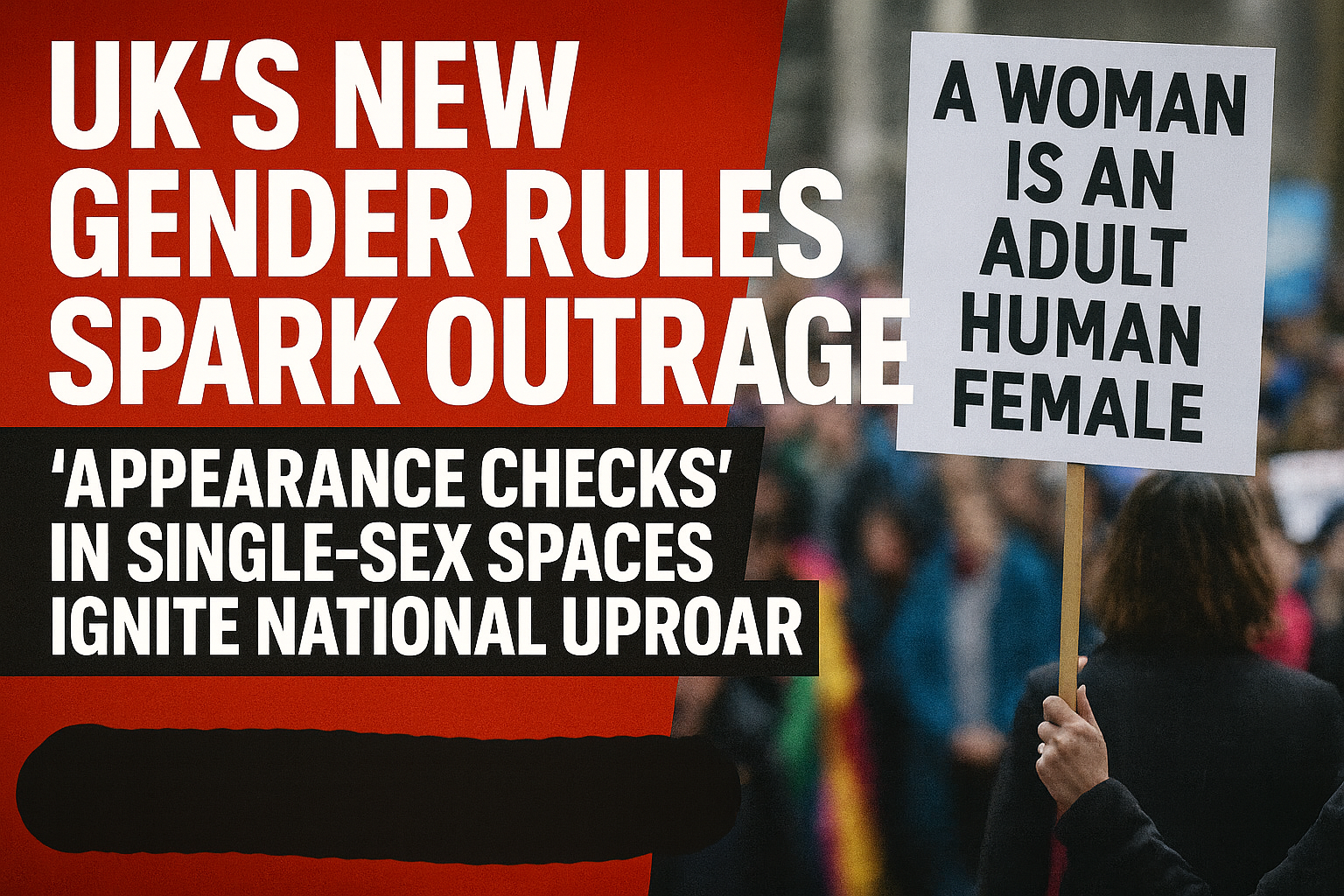
The UK is once again at the epicentre of a heated national debate after leaked guidance revealed the proposed implementation of appearance-based checks in single-sex spaces. The draft code of practice from the Equality and Human Rights Commission (EHRC) has triggered sharp criticism and protests amid tensions between safeguarding single-sex rights and protecting trans-inclusive access.
What’s happening now
In April 2025 the Supreme Court of the United Kingdom ruled that under the Equality Act 2010 the words “sex”, “man” and “woman” refer to biological sex at birth, not a gender recognition certificate or acquired gender. Harvard Kennedy School+3House of Commons Library+3Capital Law+3
That ruling set the legal foundation. Since then the EHRC has developed new guidance for how services and public spaces should act given that definition.
A draft of that guidance emerged in late November 2025 via leaks to major news outlets. According to the documents, service providers such as hospitals, changing rooms, gyms, shelters and toilets could — in certain circumstances — refuse access or require proof of biological sex based on appearance, behaviour or third-party complaint. The Independent+2Telegraph+2
The government is publicly stating that it is “taking time to get this right” before finalising the code. Ministers indicate they want to avoid rash decisions that trigger legal challenges. The Guardian
Why the reaction is intense
The fallout has been rapid and fierce. On one side, supporters argue that the supreme-court interpretation restores clarity around women’s rights and single-sex services. On the other, critics say the appearance-based checks amount to discrimination and invite a policing of gender expression.
Advocacy organisations describe the leaked guidance as a “misogynist’s charter” that legitimises exclusions of transgender and non-binary people by reference to how they look. QueerAF+1 One campaigner said: “This is a licence to discriminate based on looks, plain and simple.” QueerAF
Meanwhile, public service providers face a major operational challenge: how do you design and enforce access policies that respect the ruling while avoiding chaos or discrimination? Some institutions fear legal risk if they misapply the new rules.
Political implications
The issue intersects neatly with wider immigration and identity-politics controversies currently roiling Westminster. As the government emphasises control and clarity, some backbenchers warn that heavy-handed measures may alienate younger, more liberal voters.
In addition, the Labour Government’s Equalities Minister, Bridget Phillipson, has to navigate internal party divides between those demanding protections for biological women and those calling for trans-inclusive approaches. The issue threatens to become a litmus test for the party’s social-policy credentials ahead of the next election.
What the guidance says — draft highlights
Key leaked passages include:
- Service providers may exclude individuals from a sex-segregated space if staff “reasonably believe” the individual is not of the required biological sex, based on appearance, behaviour or others’ concerns. Telegraph+2The Independent+2
- The words “male” and “female” in service provisions refer to biological sex, not acquired gender. House of Commons Library+1
- The guidance instructs companies and public bodies to review policies, including toilets, wards, hostels and sports teams, to ensure compliance. Failure to provide single-sex facilities may risk indirect sex discrimination against biological women. The Times+1
Reactions from across the board
- Women’s rights groups: Some welcome the supreme court decision as a victory for biological sex-based protections. They argue it ensures the rights of women who rely on female-only services. Equality and Human Rights Commission+1
- LGBTQ+ and trans organisations: They see the draft guidance as regressive. For example, one group said the code would lead to “bathroom policing” of anyone who fails to conform to narrow gender stereotypes. QueerAF+1
- Business, public-service operators: Many are cautious. They warn the guidance could create legal pitfalls, push out trans staff or customers, and generally increase complexity and costs of compliance. The government has acknowledged the scale of the challenge. The Guardian
What’s next — pivotal moments to watch
- Final publication of EHRC code – The timing and nuts-and-bolts of the final guidance will set the shape of how widely and rigorously appearance-based checks are used.
- Judicial review – Legal action is anticipated against any version seen as discriminatory. The delays in publication reflect concerns about triggering litigation. The Guardian+1
- Sector-specific roll-out – Schools, hospitals, workplaces, sports clubs will all respond differently. Some may adopt conservative implementation; others may resist. The NHS, for example, has already been warned to update its single-sex accommodation rules. The Guardian
- Public and political response – Polling and protests will matter. If the guidance is seen as heavy-handed, it could feed into broader backlash around government fairness, identity politics and social cohesion.
- Operational fallout – On the ground, the consequences could include staff training needs, facility redesigns, complaint procedures, legal protections for trans individuals, and questions of enforcement and oversight.
Conclusion
The UK’s leaked guidance on single-sex spaces marks a turning point in a fraught debate over sex, gender and rights. What began as a legal clarification from the Supreme Court has become a lightning rod for wider cultural and political conflicts. With appearance-based checks now on the table, the balancing act between protecting biological women’s rights and avoiding discrimination against trans and gender-nonconforming people has never been more delicate.
As the final code of practice approaches, both public bodies and private providers must brace for new operational realities. Meanwhile, the political fallout shows little sign of letting up — and for many citizens, the fight over access to toilets or changing rooms has become symbolic of much larger questions about identity, fairness and belonging.