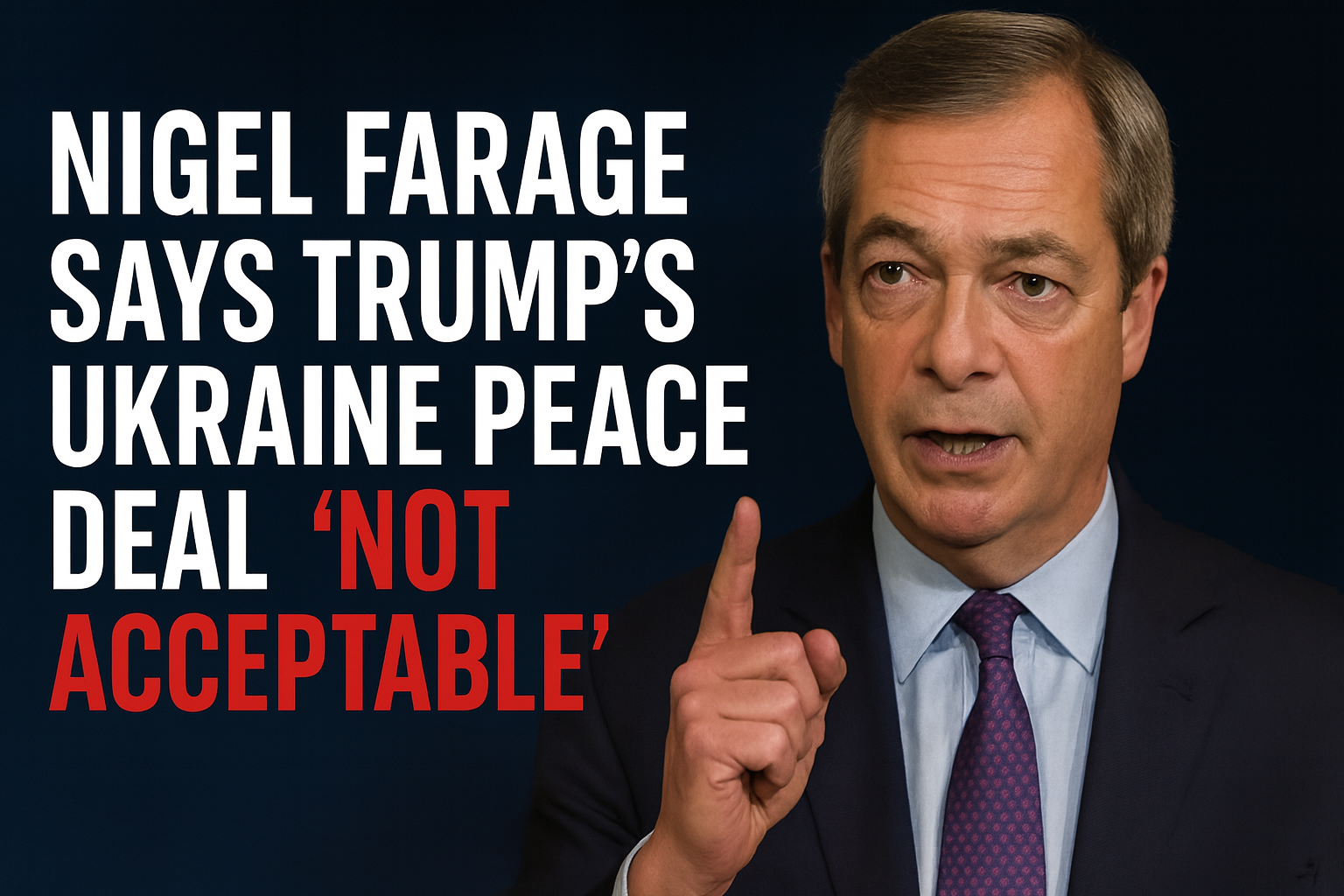
Nigel Farage has issued a clear public rebuke of Donald Trump’s proposed peace plan for Ukraine, calling the terms on offer to Kyiv “not acceptable”. Telegraph The criticism marks a notable departure for Farage, whose political brand has long featured strong alignment with Trump-style populism. In doing so, Farage also appears to reposition himself — and his party, Reform UK — on the Ukrainian conflict and UK foreign policy in a way that may have strategic implications domestically and internationally.
What’s in Trump’s Deal — And Why Farage Objects
According to the original report, Trump’s peace plan includes demanding that Ukraine:
- Slashes its army from around 1 million personnel to 600,000. Telegraph
- Cedes territory to Russia, including land it does not currently hold. Yahoo News+1
- Abandons membership or ambitions to join NATO, and accepts restrictions on hosting foreign troops/aircraft. Telegraph+1
Farage’s specific complaint: “I don’t think Ukraine being asked to halve the size of their army is acceptable.” Telegraph
He describes the overall terms as unacceptable — essentially arguing that the deal hands too much to Russia and undercuts Ukraine’s ability to defend itself.
Why This Matters: Farage’s Foreign-Policy Pivot
Reputational Stakes
Farage has faced repeated accusations of being soft on Russia or sympathetic to Kremlin interests — especially after earlier comments that the West “provoked” Russia’s invasion of Ukraine. Wikipedia+1 By publicly rejecting Trump’s deal, and aligning with Ukraine’s position, Farage may be trying to counter those narratives.
Domestic Political Implications
For Reform UK, this move offers key advantages:
- It helps placate voters who support Ukraine and are uneasy about Farage’s past Russia-friendly comments.
- It gives him more credible ground to say: “I support Ukraine’s defence — just not a deal that makes it weaker.”
- It opens a space distinct from the mainstream Tory/ Labour foreign-policy consensus while appealing to populist/skeptic voters.
Diplomatic/International Implications
Farage’s stance places him closer to the emerging European majority that views Trump’s deal as a capitulation to Russia. If the UK Government or other European actors rally against the deal, Farage’s alignment could position him as more credible in international dialogues around Ukraine.
The Bigger Picture: Why Many Fear Trump’s Deal
Critics of the deal—including senior Western diplomats and Ukrainian officials—warn that the terms risk:
- Freezing in Russian territorial advances as legitimate outcomes rather than reversing them.
- Weakening Ukraine’s defense capability and eroding broader European security.
- Undermining NATO’s deterrent value and encouraging further Russian aggression. Yahoo News+1
In short: A peace deal is desirable, but many argue it must be equitable, protect Ukrainian sovereignty, and safeguard a rules-based order.
What This Tells Us about Farage’s Strategy
- Farage is not abandoning his long-standing skepticism of NATO/EU expansion entirely; he retains a nationalist/populist core.
- But he is signaling willingness to draw a line: support for Ukraine’s defense rather than an imposed settlement that looks like a Russian victory.
- The move suggests that if the Reform UK leader becomes more influential, the UK right-wing discourse could shift to emphasis sovereignty, defence, and realist peace terms — rather than unconditional negotiation or appeasement.
What to Watch Moving Forward
- Will Farage formally alter his foreign-policy platform to emphasis stronger backing for Ukraine and less blame on the West?
- How will Reform UK voters respond to this repositioning — especially those who were drawn by the anti-war/negotiation narrative?
- How will this affect Farage’s relationship with Trump and the US populist right? Will his rebuke lead to backlash or realignment?
- How will UK domestic parties — Conservatives and Labour — respond? Could this narrow the space for them to attack Farage as “Putin-friendly”?
- How will Europe react if Trump pursues the deal despite European objections? Could Farage become a bridge between EU skeptics and pro-Ukraine hawks?
Conclusion
Nigel Farage’s public rejection of Donald Trump’s Ukraine peace deal is more than one politician dissenting from a proposal. It is a sign-post of shifting alignment: a populist leader choosing to side with Ukrainian defence rather than a transactional settlement that appears skewed in Russia’s favour.
For UK politics, it may soften some criticisms of Farage’s Russia stance, while redefining his position on foreign policy — from “West provoked war” to “West must not give in to bad deals”. In doing so, he recalibrates the populist agenda around sovereignty, defence, and fair-deal peace rather than purely negotiation.
As the Ukraine war grinds on and peace negotiations loom, Farage’s positioning may carry greater weight — both in London and in Washington.
For Reform UK, it could mark a strategic pivot: from Brexit/anti-establishment politics towards a more traditional defense-and-sovereignty posture. The question now: will the electorate buy it?