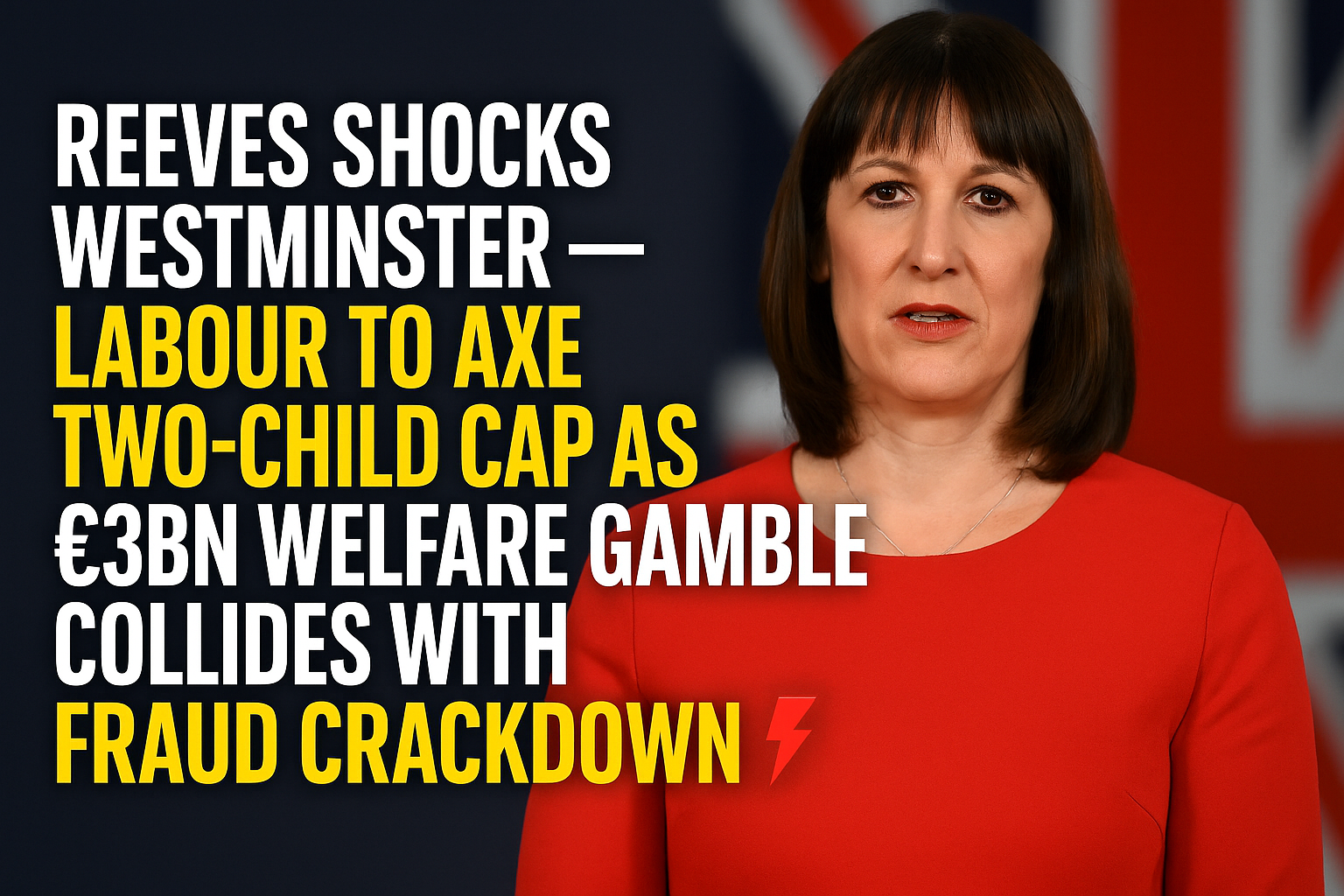
In one of the most consequential welfare decisions since Labour entered power, Chancellor Rachel Reeves has signalled that the government will scrap the controversial two-child benefit cap, a move expected to cost around £3 billion. The announcement comes alongside a newly launched benefit fraud crackdown, aimed at recovering £1.2 billion of losses by 2031—setting the stage for a dramatic clash between social investment and fiscal discipline.
The Treasury insists both actions form part of Labour’s broader “responsible but compassionate” economic strategy. But critics across Westminster have already warned that the decision may ignite a fresh political battle over welfare spending, fairness, and the long-term sustainability of the UK benefits system.
Why Labour Is Scrapping the Two-Child Cap
Introduced in 2017 under Conservative leadership, the two-child cap prevents families from claiming child tax credit or Universal Credit for a third or subsequent child. Charities, child-poverty campaigners and Labour MPs have long argued that the policy disproportionately harmed low-income households, pushing thousands of children into poverty.
The Treasury has now confirmed that removing the cap:
- Will lift an estimated tens of thousands of children out of poverty
- Marks a major shift toward tackling child deprivation and inequality
- Aligns with Labour’s pledge to ‘end the cycle of inherited disadvantage’
Reeves has framed the decision as a “moral and economic necessity,” arguing that failing to act would cost the country more in the long run through lost productivity and increased social pressures.
But critics say Labour must explain how the £3BN annual cost will be consistently funded without deep cuts elsewhere.
The Fraud Crackdown: A Counter-Move to Calm Fiscal Concerns
At the same press briefing, Reeves laid out a tough new fraud-prevention strategy, which includes:
- Enhanced data-matching tools using AI and cross-department data
- Stronger penalties for deliberate benefit abuse
- Recruitment of new investigators within DWP
- Targeted recovery programmes for long-term overpayments
Officials project that the crackdown could recover £1.2BN by 2031, a figure aimed to demonstrate that Labour is not engaging in “unfunded generosity” but balancing compassion with control.
The messaging is clear: Labour wants voters—and markets—to believe that it can expand support for families without losing grip of the public purse.
A High-Risk Balancing Act for Reeves and Starmer
Economists, unions, and business lobby groups have issued mixed reactions:
✔ Child-poverty campaigners welcomed the decision
They argue that the two-child cap was one of the “most harmful social policies” of the past decade. Many see the move as a historic moment in the fight against poverty.
✔ Unions say the policy is a ‘moral correction’
But they also urge the government to raise child benefits and minimum wage levels to match inflation and restore real-term incomes.
✖ Business groups remain wary
The CBI and major investor networks warn that Labour must ensure the Budget remains credible. Maintaining investor confidence will be crucial if the government is to avoid rising borrowing costs.
✖ Fiscal conservatives accuse Labour of ‘reckless spending’
Opponents argue that removing the cap could encourage larger family sizes and strain a system already under pressure.
This leaves Reeves walking a tightrope: boosting support for families while reassuring markets that Labour will not repeat the economic instability of recent years.
Why This Matters for the Average UK Household
The policy shift could have wide-ranging effects:
- Tens of thousands of families will see immediate financial relief, especially those with more than two children.
- Poverty levels may fall, particularly among minority families and single-parent households.
- Taxpayer confidence will be tested, depending on the success of the fraud crackdown.
- The Autumn Budget will be under intense scrutiny, with voters expecting clarity on costings and long-term fiscal responsibility.
With living costs still high, wages stagnant, and public services stretched, many households will be watching closely to see whether this marks the beginning of a broader shift toward social investment.
What Comes Next?
All eyes now turn to the Autumn Budget, where Reeves must outline:
- How the £3BN removal of the two-child cap will be funded
- How fraud-recovery mechanisms will operate
- Whether taxes will rise or spending will fall elsewhere
- What additional support low-income families can expect
Political analysts expect this to be one of the defining moments of Labour’s first year in power—and a potential turning point in the UK’s post-austerity era.