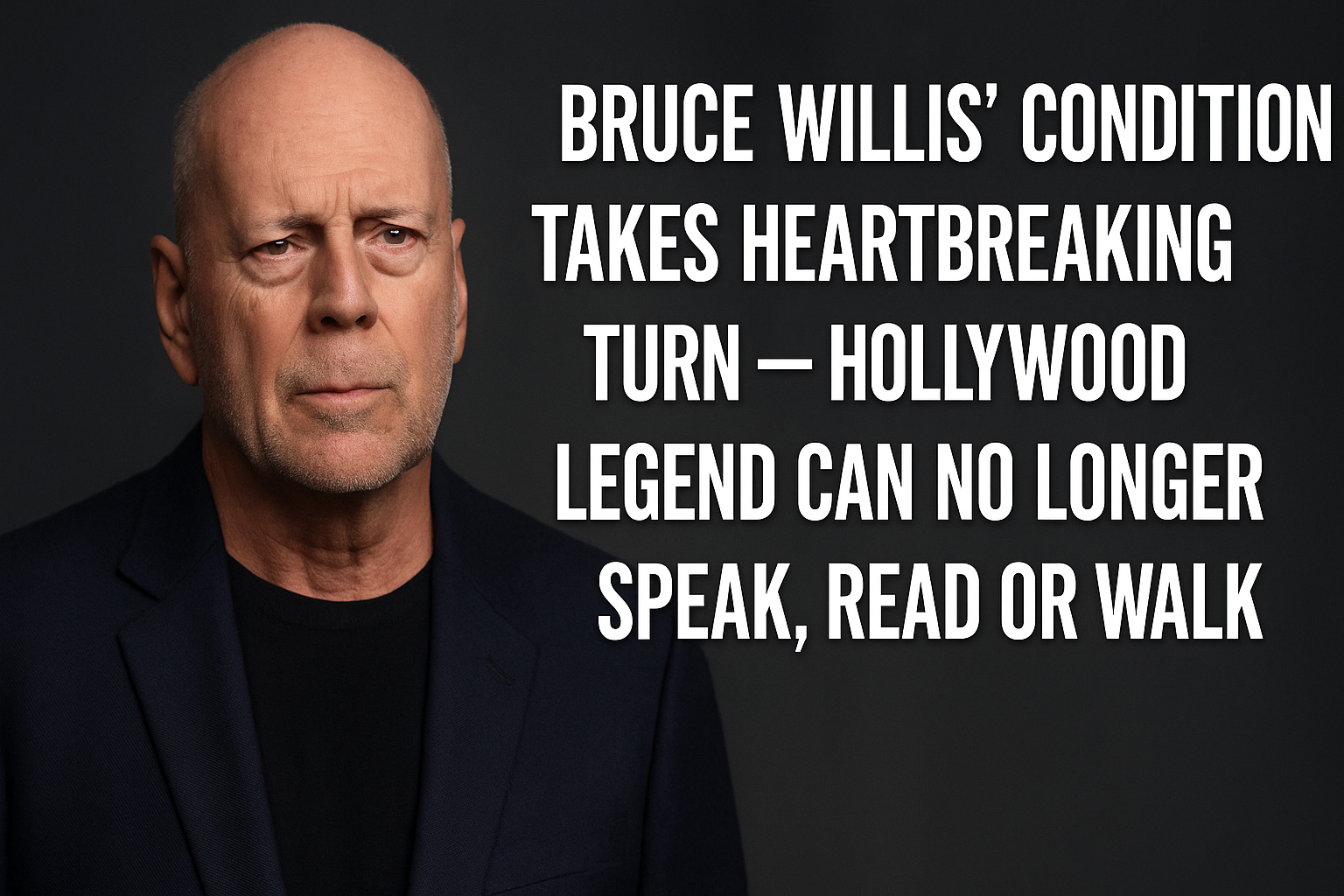
Bruce Willis, the action-movie giant beloved worldwide for his iconic roles in Die Hard, The Sixth Sense, Pulp Fiction and more, is facing the most devastating phase yet of his battle with frontotemporal dementia (FTD). New reports suggest the 70-year-old star can no longer speak, read or walk, marking a deeply saddening chapter in a journey that has captured global attention and sympathy.
Once known for his sharp wit, unmistakable voice and unmatched on-screen presence, Willis’ condition has deteriorated significantly, leaving fans and loved ones heartbroken.
A Long and Painful Journey Since His Diagnosis
Bruce Willis’ health struggles first became public in March 2022, when his family announced he had been diagnosed with aphasia, a condition affecting communication and language. The announcement shocked Hollywood, as Willis had quietly continued working despite growing cognitive challenges.
By early 2023, doctors confirmed a more specific and much more serious diagnosis:
👉 Frontotemporal Dementia (FTD) — a progressive brain disorder that affects behaviour, communication, and mobility.
Unlike Alzheimer’s, FTD often strikes earlier and progresses more aggressively. For Willis, the decline has been rapid, leaving him “not fully aware of the condition he’s living with,” according to family members quoted across international media.
Reportedly Unable to Communicate or Move Independently
The latest updates paint a heartbreaking picture: Willis is now believed to be unable to speak, unable to read and struggling to walk, according to multiple widely reported sources. Friends close to the family say:
- He no longer follows conversations.
- He often does not recognise familiar faces.
- Mobility issues have intensified, requiring full-time assistance.
These symptoms align with advanced FTD, which can affect not only cognitive functions but also the muscular systems responsible for movement.
One relative reportedly described his current state as “a shadow of the man he once was,” emphasising the emotional toll the illness has taken on those closest to him.
A Family United in Care and Love
Throughout the ordeal, Willis’ family has remained steadfastly supportive. His wife, Emma Heming Willis, continues to advocate for dementia awareness, frequently reminding the public that FTD is a “family disease” — one that affects far more than the patient alone.
His daughters — Rumer, Scout, Tallulah, Mabel and Evelyn — have been open about the emotional difficulties. Rumer previously shared that while her father cannot express recognition in traditional ways, “he still feels love, and that is enough.”
The family has chosen to stay private about many aspects of his care, but every public update has sent waves of compassion across the globe.
A Hollywood Career That Changed the Industry Forever
Bruce Willis’ career spans more than four decades, transforming him from a comedy-drama TV actor into one of the biggest box-office stars of all time.
Career Highlights Include:
- John McClane in the Die Hard franchise
- The Sixth Sense
- Pulp Fiction
- Looper
- Armageddon
- Moonlighting
- Unbreakable and its sequels
Willis brought a uniquely human charm to action films — blending toughness with vulnerability, humour and heart. His impact on cinema remains undeniable, and his characters will be celebrated for generations.
With more than 100 film credits, dozens of awards, and a legacy etched into Hollywood history, Willis’ contribution to global entertainment is nothing short of legendary.
Understanding Frontotemporal Dementia (FTD)
FTD is a rare degenerative brain disorder that affects the frontal and temporal lobes. It often strikes individuals in their 50s and 60s, but progression varies widely.
Common symptoms include:
- Language loss
- Difficulty speaking or understanding speech
- Behavioural changes
- Loss of mobility
- Decline in problem-solving and decision-making abilities
There is currently no cure, and treatment focuses solely on symptom management and comfort.
Medical specialists say Willis’ fast decline aligns with severe FTD progression, especially in cases where communication and motor skills deteriorate simultaneously.
Global Reaction: Fans, Co-Stars and Celebrities Show Support
Since the latest reports surfaced, social media has been flooded with tributes from fans and fellow actors. Many describe Willis as “a true gentleman,” “a Hollywood powerhouse,” and “a legend whose performances shaped a generation.”
Co-stars from across his filmography have expressed shock at the rapid decline, calling for more public awareness around dementia and the need for greater support for families of those affected.
His long-term collaborators, including directors and producers, continue to share memories of his dedication, comedic timing, and relentless work ethic.
A Legacy That Will Always Shine
While Bruce Willis can no longer speak the lines that once defined blockbuster cinema, his voice still echoes across decades of unforgettable performances. His films remain part of cultural history, and his influence on modern action storytelling is profound.
For millions of fans worldwide, Willis is — and will always be — a hero. Even as his illness progresses, his legacy stands tall: a testament to resilience, charisma and the timeless power of storytelling.
The world continues to watch his journey with compassion, respect and admiration, hoping his remaining years are filled with comfort, love and dignity.